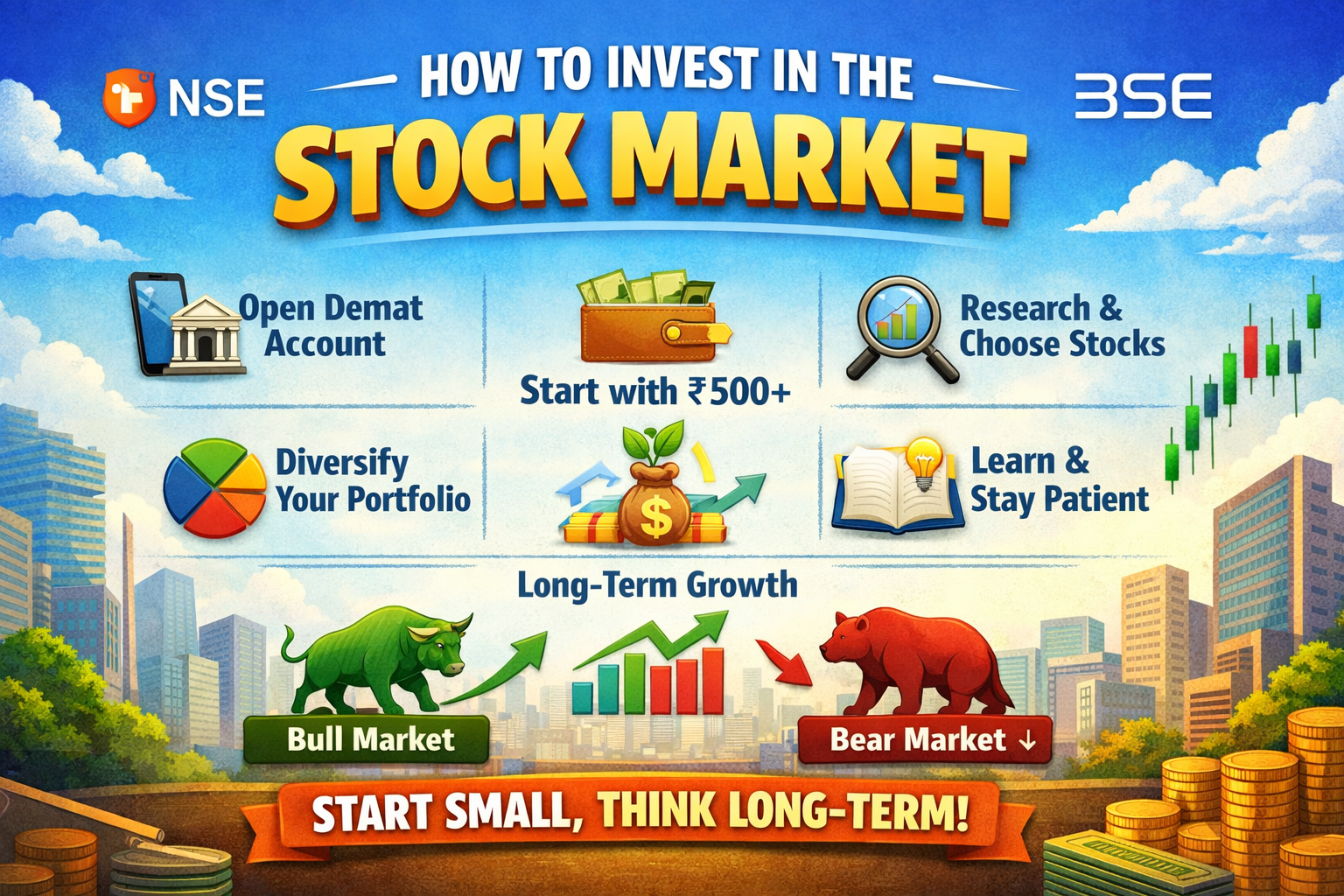
Investing in the stock market sounds exciting and intimidating at the same time. One moment you hear stories of people building wealth, and the next you see headlines about market crashes. So, what’s the truth?
The truth is simple: the stock market is one of the most reliable ways to build long-term wealth if you understand how it works and invest wisely.
This guide breaks everything down in a clear, practical, and human way. No jargon overload. No fake promises. Just real strategies backed by trusted financial principles.
What Is the Stock Market?
The stock market is a place where investors buy and sell shares of publicly listed companies. When you buy a stock, you own a small piece of that company.
In India, the two major stock exchanges are:
Companies list their shares here to raise capital, and investors trade these shares based on demand, supply, and company performance.
Simple Example
If you buy shares of a company like Reliance Industries, you become a partial owner. If the company grows, your investment grows too.
Why Should You Invest in the Stock Market?
Let’s address the big question: why not just keep money in a savings account?
1. Higher Returns Than Traditional Options
Historically, equities outperform fixed deposits and savings accounts over the long term. According to data from Securities and Exchange Board of India (SEBI), equities have delivered strong inflation-beating returns over time.
2. Power of Compounding
Investing early lets your money grow exponentially. Think of it as a snowball—small at first, but powerful over time.
3. Ownership in Businesses
You don’t just invest—you participate in the growth of real companies.
4. Liquidity
Unlike real estate, stocks can be bought or sold quickly.
Things You Must Know Before Investing
Before jumping in, understand these fundamentals.
Risk and Reward Go Together
Higher returns come with higher risks. There is no “guaranteed” profit in stocks.
Market Volatility Is Normal
Prices move daily. Don’t panic when markets dip—it’s part of the game.
Long-Term Thinking Wins
Short-term trading often leads to losses for beginners. Long-term investing builds wealth.
Step-by-Step Guide: How to Invest in the Stock Market
Let’s break the process into simple steps.
Step 1: Set Clear Financial Goals
Ask yourself:
- Are you investing for retirement?
- Buying a house?
- Building wealth?
Your goal defines your strategy.
Step 2: Decide How Much You Can Invest
Never invest money you might need urgently.
A good rule:
- Keep an emergency fund (3–6 months of expenses)
- Invest only surplus money
Step 3: Open a Demat and Trading Account
To invest in India, you need:
- Demat Account – Holds your shares electronically
- Trading Account – Used to buy/sell stocks
Popular brokers include:
Step 4: Complete KYC
You’ll need:
- PAN card
- Aadhaar card
- Bank account
- Mobile number
This process is mandatory under SEBI regulations.
Step 5: Learn Basic Stock Market Concepts
Before investing, understand:
- Market capitalization
- P/E ratio
- Dividend
- Earnings growth
These help you evaluate companies properly.
Step 6: Start with Blue-Chip Stocks
Beginners should start with stable, well-known companies.
Examples include:
These companies have strong fundamentals and lower risk compared to smaller firms.
Step 7: Diversify Your Portfolio
Don’t put all your money into one stock.
Spread your investments across:
- Different sectors (IT, banking, FMCG)
- Multiple companies
Diversification reduces risk.
Step 8: Invest Regularly (SIP Strategy)
Instead of investing a lump sum, invest small amounts regularly.
This approach:
- Reduces market timing risk
- Builds discipline
- Works well during volatility
Types of Stock Market Investments
1. Equity Stocks
Direct ownership in companies.
2. Mutual Funds
Professionally managed funds pooling investor money.
3. Exchange-Traded Funds (ETFs)
Track indices like Nifty 50.
4. Index Funds
Low-cost funds that mirror market performance.
Common Mistakes to Avoid
Even smart people make silly mistakes in the stock market.
1. Following the Crowd
If everyone is buying a stock, it might already be overpriced.
2. Trying to Time the Market
Even experts struggle with perfect timing.
3. Ignoring Research
Blind investing = blind risk.
4. Overtrading
Frequent buying and selling increases costs and reduces returns.
5. Emotional Investing
Fear and greed are your biggest enemies.
Smart Strategies for Beginners
Think Long-Term
Stay invested for years, not days.
Focus on Fundamentals
Look at company earnings, growth, and management.
Use SIP Approach
Consistency beats timing.
Reinvest Profits
Let compounding work its magic.
How to Analyze Stocks (Simple Framework)
You don’t need a finance degree. Start with basics.
1. Check Revenue Growth
Is the company growing consistently?
2. Look at Profit Margins
Higher margins often indicate strong business efficiency.
3. Study Debt Levels
Too much debt = higher risk.
4. Understand the Business Model
If you don’t understand how the company makes money, skip it.
Tax on Stock Market Investments in India
Taxes matter. Ignoring them is like ignoring a hidden cost.
Short-Term Capital Gains (STCG)
- Applicable if sold within 1 year
- Tax rate: 15%
Long-Term Capital Gains (LTCG)
- Applicable after 1 year
- Tax rate: 10% (above ₹1 lakh gains)
These rules are defined by Indian tax laws and regulated under SEBI guidelines.
How Much Money Do You Need to Start?
Here’s the good news: you don’t need lakhs.
You can start with as little as ₹100–₹500 using fractional investments or SIPs in mutual funds.
The key is consistency, not the starting amount.
Is Stock Market Investing Safe?
Short answer: Yes, if done correctly.
Safe Investing Means:
- Long-term focus
- Diversification
- Research-based decisions
Risky Investing Means:
- Blind tips
- Short-term trading without knowledge
- Emotional decisions
Realistic Expectations (No Get-Rich-Quick Myths)
Let’s be honest.
The stock market is not a lottery ticket.
You won’t double your money overnight. But over time, disciplined investors often see strong returns.
A realistic expectation:
- 10–15% annual returns over the long term (based on historical equity performance trends)
Trusted Sources You Can Learn From
To build trust and stay informed, rely on credible sources:
- Securities and Exchange Board of India – Official regulations and investor education
- Reserve Bank of India – Economic insights
- NSE & BSE official websites – Market data
Avoid random social media tips. If someone promises “guaranteed returns,” run.
Final Thoughts
Investing in the stock market is not about luck—it’s about discipline, knowledge, and patience.
Start small. Learn continuously. Stay consistent.
And remember:
The market rewards those who stay calm when others panic and stay patient when others rush.
If you approach investing with the right mindset, the stock market can become one of the most powerful tools for financial growth.
FAQs
1. Can beginners invest in the stock market?
Yes, anyone can start. You just need a Demat account and basic knowledge.
2. Is it better to invest or trade?
Investing is safer for beginners. Trading requires experience and higher risk tolerance.
3. How long should I stay invested?
Ideally, 5+ years to see meaningful returns.
4. Can I lose all my money?
Only if you invest without research or put all money into risky stocks. Diversification reduces this risk.
5. What is the best time to invest?
The best time is when you are financially ready. Time in the market matters more than timing the market.
If you want, I can also create SEO meta title, description, tags, and internal linking strategy for this article to help it rank faster.