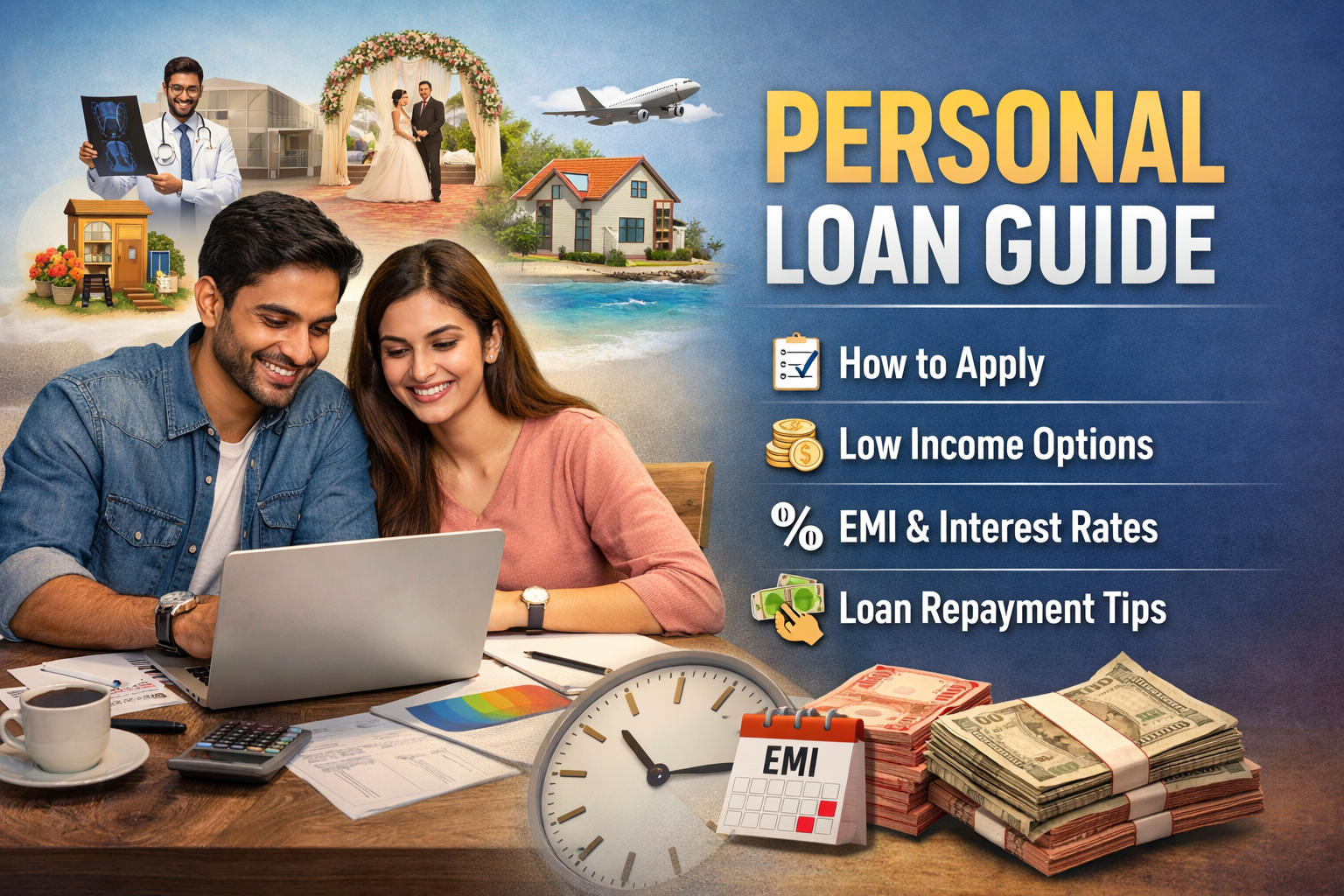
Taking a personal loan sounds simple fill a form, get money, repay later. But in reality, one wrong step can cost you thousands in interest.
This guide breaks everything down in a clean, practical way. You’ll learn how personal loans work, how to apply, what mistakes to avoid, and how to get the best deal without hurting your finances.
Let’s get straight to it.
What Is a Personal Loan?
A personal loan is an unsecured loan. You don’t need to pledge assets like gold, property, or a car. Banks and NBFCs approve it based on your income, credit score, and repayment capacity.
You can use the money for almost anything:
- Medical emergencies
- Wedding expenses
- Travel
- Home renovation
- Debt consolidation
That flexibility makes personal loans popular but also risky if you don’t plan properly.
How Personal Loans Work
Here’s the basic structure:
- You borrow a fixed amount
- The lender charges interest
- You repay through EMIs (Equated Monthly Installments)
- The tenure usually ranges from 1 to 5 years
Your EMI depends on three factors:
- Loan amount
- Interest rate
- Loan tenure
Short tenure = higher EMI, less interest
Long tenure = lower EMI, more total interest
Simple math, but many people ignore it and regret it later.
Types of Personal Loans
Not all personal loans are the same. Lenders often classify them based on purpose.
1. Standard Personal Loan
The most common type. No questions asked about usage.
2. Debt Consolidation Loan
Used to combine multiple debts into one EMI. Helpful if you manage credit cards poorly.
3. Medical Emergency Loan
Quick approval, often within hours. Slightly higher interest due to urgency.
4. Wedding Loan
Tailored for wedding expenses. Popular in India due to high wedding costs.
5. Travel Loan
Funds your vacations—but remember, you’ll repay long after the trip ends.
Who Can Apply for a Personal Loan?
Most lenders follow similar eligibility criteria:
- Age: 21 to 60 years
- Stable income (salaried or self-employed)
- Minimum monthly income (varies by lender)
- Good credit history
What About Credit Score?
Your credit score plays a huge role. In India, lenders rely heavily on scores from CIBIL.
- 750+ → Excellent (best interest rates)
- 650–750 → Average (moderate rates)
- Below 650 → Risky (higher rates or rejection)
A low score doesn’t block you completely but it makes your loan expensive.
Documents Required
Keep these ready before applying:
- Identity proof (Aadhaar, PAN)
- Address proof
- Income proof (salary slips or ITR)
- Bank statements (last 3–6 months)
- Employment details
Missing documents can delay approval. Lenders don’t like incomplete files.
Step-by-Step: How to Take a Personal Loan
Let’s simplify the process.
Step 1: Check Your Eligibility
Use online calculators to estimate:
- Loan amount
- EMI
- Interest rate
This step saves time and avoids rejection.
Step 2: Compare Lenders
Don’t rush. Compare banks and NBFCs.
Look at:
- Interest rates
- Processing fees
- Prepayment charges
- Customer reviews
Even a 1% lower interest rate can save a lot over time.
Step 3: Choose the Right Loan Amount
Borrow only what you need not what you qualify for.
Banks may offer more money than you need. That’s not generosity. That’s business.
Step 4: Apply Online or Offline
Most lenders offer instant online applications.
You:
- Fill the form
- Upload documents
- Verify identity (OTP or video KYC)
Approval can take minutes to a few days.
Step 5: Loan Approval and Disbursal
Once approved:
- You receive a loan offer
- Review terms carefully
- Accept agreement
Funds usually reach your account within 24–72 hours.
Interest Rates: What You Must Know
Personal loan interest rates in India usually range between 10% and 24% per year.
Why such a big range?
Because lenders assess risk.
Factors affecting your rate:
- Credit score
- Income stability
- Employer reputation
- Existing debts
A government employee with a high credit score pays less interest than a freelancer with irregular income.
Hidden Charges You Should Never Ignore
Here’s where most people lose money.
Common Charges:
- Processing fee (1–3%)
- Late payment penalty
- Prepayment charges
- GST on fees
Always read the fine print.
If a deal looks “too good,” check the hidden fees. They often hide there.
How to Improve Your Loan Approval Chances
Want faster approval and better rates? Do this:
1. Maintain a High Credit Score
Pay credit card bills on time. No excuses.
2. Reduce Existing Debt
Lower your debt-to-income ratio.
3. Choose the Right Tenure
Balance EMI and total interest.
4. Apply with the Right Lender
Some lenders prefer salaried employees. Others support self-employed individuals.
Smart Tips Before Taking a Personal Loan
Let’s be practical.
- Don’t take a loan for luxury purchases
- Always calculate EMI before applying
- Keep emergency savings separate
- Avoid multiple loan applications at once
Too many applications hurt your credit score.
When Should You Take a Personal Loan?
A personal loan makes sense when:
You face a medical emergency
You consolidate high-interest debt
You handle unavoidable expenses
Avoid it for:
Impulse shopping
Expensive gadgets
Lifestyle upgrades
Future-you will thank present-you.
Personal Loan vs Credit Card: Which Is Better?
Both serve different purposes.
| Feature | Personal Loan | Credit Card |
|---|---|---|
| Interest Rate | Lower | Very High |
| Tenure | Fixed | Revolving |
| Best For | Large expenses | Short-term spending |
If you carry credit card debt, converting it into a personal loan can save money.
Risks of Personal Loans
Let’s not sugarcoat it.
1. High Interest Cost
You may repay much more than you borrowed.
2. Debt Trap
Easy approval can lead to over-borrowing.
3. Credit Score Damage
Missed EMIs hurt your financial future.
Real Data and Trusted Insights
According to guidelines from the Reserve Bank of India:
- Lenders must disclose all charges clearly
- Borrowers should receive transparent loan agreements
- Fair practices must be followed
Also, credit behavior tracked by TransUnion CIBIL shows that borrowers with disciplined repayment history get significantly better loan terms.
These are not opinions they are industry-backed facts.
Common Mistakes to Avoid
Let’s keep this simple and honest.
- Ignoring total repayment cost
- Choosing long tenure without thinking
- Not comparing lenders
- Missing EMI payments
- Taking loans for unnecessary expenses
One mistake can cost years of financial stress.
FAQs: How to Take a Personal Loan
1. How fast can I get a personal loan?
Many lenders approve loans within 24–48 hours if documents are complete.
2. What is the minimum credit score required?
Most lenders prefer 700+, but some accept lower scores with higher interest rates.
3. Can I prepay my personal loan?
Yes, but some lenders charge prepayment fees. Check terms before signing.
4. Is a personal loan safe?
Yes, if you borrow responsibly and repay on time.
5. Can self-employed individuals apply?
Absolutely. You just need stable income proof and financial records.
Final Thoughts
A personal loan can solve problems—or create new ones. It depends on how you use it.
Borrow smart.
Read every detail.
Plan your repayment before you take the loan—not after.
Money feels easy when it arrives. It feels heavy when you repay it.
Choose wisely.
SEO Keywords Used Naturally:
- how to take a personal loan
- personal loan process
- personal loan eligibility
- personal loan interest rates
- documents required for personal loan
If you want, I can also:
- Add internal + external SEO links
- Generate meta title & description
- Create schema markup for ranking
- Suggest high-ranking keywords for India
Just tell me 👍