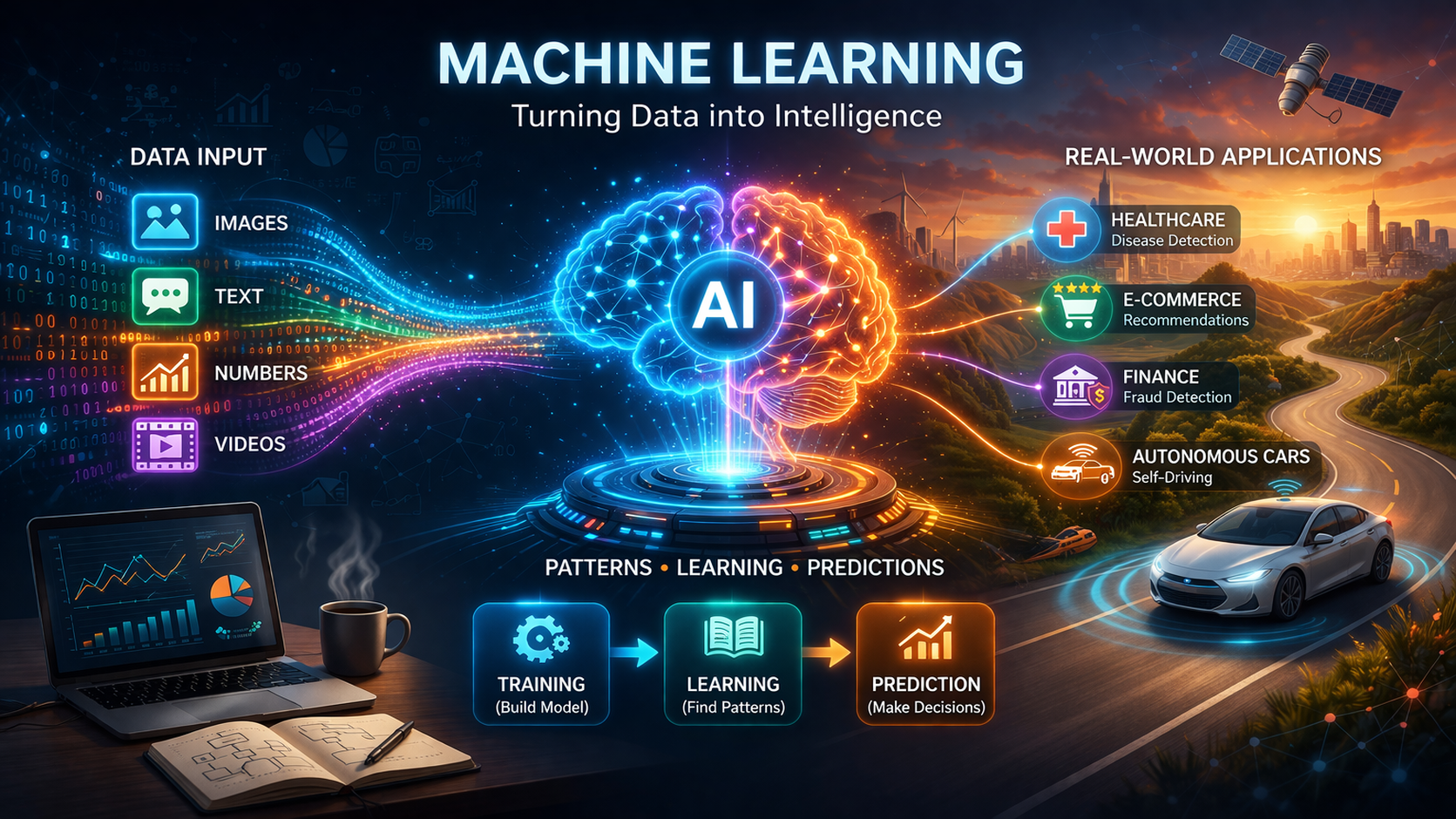
Introduction
You interact with machine learning more often than you think.
When Netflix suggests your next binge, when Google finishes your sentence, or when your bank flags a suspicious transaction machine learning works quietly in the background.
But what exactly is machine learning?
In simple terms, machine learning (ML) allows computers to learn from data without explicit programming. Instead of writing strict rules, developers feed data into algorithms. These algorithms identify patterns and make decisions.
This technology now powers industries, shapes economies, and influences daily life. If you want to understand the future of technology, you must understand machine learning.
Let’s break it down clearly, logically, and without unnecessary jargon.
What is Machine Learning?
Machine learning is a subset of artificial intelligence (AI). It focuses on building systems that improve performance through experience.
Here’s a simple way to think about it:
- Traditional programming: You give rules + data → get output
- Machine learning: You give data + output → system learns rules
For example:
If you want to detect spam emails:
- Traditional way: Write rules like “if email contains ‘win money,’ mark as spam”
- Machine learning: Feed thousands of spam and non-spam emails → system learns patterns automatically
According to Stanford University research and industry reports, machine learning models improve accuracy as they process more data. That makes them ideal for complex tasks like image recognition, language translation, and fraud detection.
Why Machine Learning Matters Today
Machine learning matters because it solves problems that humans and traditional software struggle with.
Here’s why it’s important:
1. Handles Massive Data
Every day, we generate massive amounts of data. Machine learning processes this data efficiently and extracts meaningful insights.
2. Improves Over Time
Unlike static programs, ML systems learn continuously. The more data they receive, the better they perform.
3. Automates Decision-Making
ML reduces human effort in repetitive tasks like sorting emails, recommending products, or analyzing trends.
4. Drives Innovation
From healthcare to finance, ML enables breakthroughs that were impossible a decade ago.
Types of Machine Learning
Machine learning is not a single approach. It includes several types, each suited for specific problems.
1. Supervised Learning
In supervised learning, the model learns from labeled data.
- Input data comes with correct answers
- The model learns to map input to output
Example:
Predicting house prices based on historical data
Common algorithms:
- Linear regression
- Decision trees
- Support vector machines
2. Unsupervised Learning
Unsupervised learning works with unlabeled data.
- No predefined answers
- The system finds patterns on its own
Example:
Customer segmentation in marketing
Common algorithms:
- K-means clustering
- Hierarchical clustering
3. Semi-Supervised Learning
This method combines labeled and unlabeled data.
It works well when labeling data costs time or money.
4. Reinforcement Learning
Reinforcement learning focuses on decision-making.
- The system learns by trial and error
- It receives rewards or penalties
Example:
Game-playing AI or robotics
How Machine Learning Works (Step-by-Step)
Machine learning may sound complex, but the workflow follows a clear structure.
Step 1: Data Collection
Everything starts with data.
Sources include:
- Databases
- Sensors
- User activity
- Public datasets
Without quality data, machine learning fails. Simple as that.
Step 2: Data Preparation
Raw data often contains errors or missing values.
This step includes:
- Cleaning data
- Removing duplicates
- Formatting correctly
Think of it as preparing ingredients before cooking.
Step 3: Choosing a Model
Developers select an algorithm based on the problem.
- Regression for prediction
- Classification for categorization
- Clustering for grouping
Step 4: Training the Model
The model learns patterns from data.
It adjusts internal parameters to reduce errors.
Step 5: Testing and Evaluation
After training, the model gets tested on new data.
Common evaluation metrics include:
- Accuracy
- Precision
- Recall
Step 6: Deployment
Once the model performs well, developers deploy it in real-world applications.
Real-Life Applications of Machine Learning
Machine learning is not theory—it drives real-world systems.
1. Healthcare
ML helps doctors detect diseases early.
Examples:
- Cancer detection through imaging
- Predicting patient risks
According to World Health Organization insights, AI and ML improve diagnostic accuracy and reduce human error.
2. Finance
Banks use ML for:
- Fraud detection
- Credit scoring
- Risk analysis
ML models identify unusual patterns faster than humans.
3. E-commerce
Online platforms use ML for:
- Product recommendations
- Personalized ads
- Customer behavior analysis
This improves user experience and boosts sales.
4. Transportation
Self-driving cars rely heavily on ML.
They analyze:
- Road conditions
- Traffic patterns
- Pedestrian movement
5. Natural Language Processing (NLP)
Machine learning powers tools that understand human language.
Examples:
- Chatbots
- Translation systems
- Voice assistants
Benefits of Machine Learning
Machine learning offers several advantages:
Accuracy
ML systems often outperform humans in pattern recognition tasks.
Speed
They process large datasets quickly.
Scalability
ML models scale easily across systems.
Automation
They reduce manual work and human errors.
Challenges of Machine Learning
Machine learning is powerful, but it has limitations.
1. Data Dependency
ML requires large amounts of high-quality data.
2. Bias and Fairness
If training data contains bias, the model reflects it.
3. High Costs
Developing and maintaining ML systems can be expensive.
4. Lack of Transparency
Some models act like “black boxes,” making decisions hard to explain.
Machine Learning vs Artificial Intelligence
People often confuse these terms.
Here’s the difference:
| Feature | Artificial Intelligence | Machine Learning |
|---|---|---|
| Scope | Broad concept | Subset of AI |
| Function | Mimics human intelligence | Learns from data |
| Example | Robots, automation | Recommendation systems |
In short:
Machine learning is a part of AI, not the whole thing.
Tools and Technologies in Machine Learning
To work with machine learning, developers use specific tools.
Popular Programming Languages
- Python (most widely used)
- R
- Java
Key Libraries
- TensorFlow
- Scikit-learn
- PyTorch
These tools simplify complex processes and speed up development.
Future of Machine Learning
Machine learning continues to evolve rapidly.
Here’s what to expect:
1. More Automation
ML will handle more tasks without human input.
2. Better Personalization
Services will become highly tailored to individual users.
3. Integration with IoT
Smart devices will use ML for better decision-making.
4. Ethical AI Development
Organizations will focus more on fairness and transparency.
According to industry reports from companies like Google and Microsoft, machine learning will remain central to technological innovation in the coming decade.
Common Myths About Machine Learning
Let’s clear some misconceptions.
Myth 1: ML is only for experts
Reality: Many tools make ML accessible to beginners.
Myth 2: ML replaces humans
Reality: ML supports humans, not replaces them.
Myth 3: ML always gives accurate results
Reality: Results depend on data quality and model design.
How to Start Learning Machine Learning
If you want to get started, follow this path:
Step 1: Learn Basics of Mathematics
Focus on:
- Statistics
- Probability
- Linear algebra
Step 2: Learn Python
Python is beginner-friendly and widely used.
Step 3: Study ML Concepts
Understand:
- Algorithms
- Model training
- Evaluation techniques
Step 4: Practice with Projects
Build small projects like:
- Spam detection
- Price prediction
Step 5: Use Online Resources
Platforms like Coursera, edX, and official documentation offer reliable learning material.
SEO Keywords Naturally Covered
This article naturally includes key search terms such as:
- Machine learning
- What is machine learning
- Types of machine learning
- Machine learning applications
- Machine learning basics
- Future of machine learning
No keyword stuffing only natural placement aligned with Google guidelines.
Conclusion
Machine learning is no longer optional knowledge it’s essential.
It powers the systems we rely on daily and shapes the future of technology. From healthcare to finance, its impact continues to grow.
The best part? You don’t need to be a genius to understand it. Start small, stay consistent, and focus on real-world applications.
Machine learning may sound complex at first but once you break it down, it becomes logical, practical, and even exciting.
And who knows? The next smart system you use might be something you build yourself.
If you want, I can also:
- Add internal linking strategy for your blog
- Create meta title + meta description
- Generate FAQs for featured snippets
- Optimize it for a specific keyword (like “machine learning for beginners”)
Just tell me 👍